

If you train consistently, care about your performance, and still find yourself dealing with repeated injuries, it can start to feel like bad luck. One setback clears up, training ramps back up, and then something else flares. A new strain. A nagging joint. A familiar pain that never fully goes away.
For many athletes, this cycle becomes normal. Injuries are framed as part of the game. Something to push through, manage, or work around. But the truth is, most injuries are not random, and they are rarely the result of a single mistake.
More often, athletes keep getting hurt because something foundational is missing.
This article will explore why so many athletes struggle to stay healthy, why training harder often makes the problem worse, and what is commonly overlooked when performance and durability are treated as separate goals. The aim is not to assign blame, but to offer clarity and a better way to understand why injuries keep showing up.

The Myth of Being “Injury-Prone”
Many athletes eventually accept the label of being injury-prone. They assume their body is fragile, poorly built, or simply not meant to handle training demands.
This belief often forms after years of recurring issues. Hamstring strains that keep coming back. Shoulder pain that flares every season. Back pain that never fully resolves.
But the idea that some athletes are inherently injury-prone misses a critical point. Injuries are rarely about weakness or toughness. They are about load meeting a system that is not fully prepared to handle it.
When the body lacks adequate movement options, balance, or capacity in certain areas, stress gets funneled into the same tissues over and over again. Eventually, those tissues fail.
Why Training Harder Often Makes Things Worse
When injuries occur, many athletes respond by training harder or focusing more aggressively on performance metrics. More lifting. More conditioning. More sport-specific work.
While intensity and volume are essential for improvement, they can also amplify existing problems if the foundation is not solid.
Training builds on what is already there. If movement limitations, asymmetries, or poor force control exist, increased training load simply magnifies those flaws.
This is why some athletes feel stronger and fitter but continue to break down. Performance improves in certain areas, while durability quietly declines.
Performance and Durability Are Not Opposites
One of the biggest misconceptions in athletics is that staying healthy requires sacrificing performance.
Athletes are often forced to choose between “getting healthy” and “getting better.” Rehab feels slow and cautious. Training feels productive and exciting.
In reality, performance and durability are deeply connected.
Athlete development works best when both are addressed together. Strength, speed, and power should be layered on top of movement quality and control, not built in isolation.
When durability is ignored, performance gains become fragile. When durability is prioritized appropriately, performance becomes more repeatable and sustainable.
The Performance Pyramid Most Athletes Never See
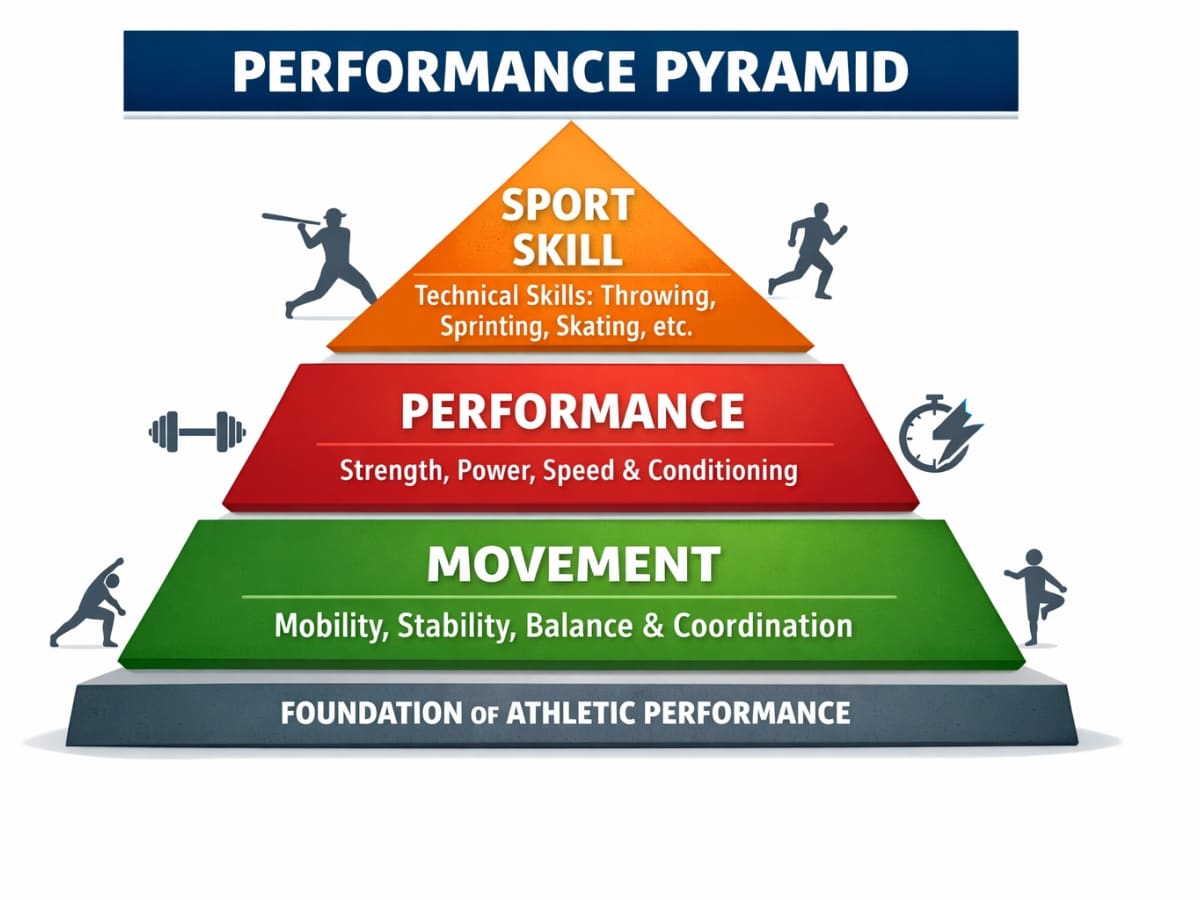
To understand why injuries keep happening, it helps to think about athletic development as a pyramid.
At the top of the pyramid are sport-specific skills. These include the technical abilities required for your sport.
The middle layer is performance. Strength, power, speed, explosiveness, and conditioning live here.
The base of the pyramid is movement. Mobility, stability, balance, coordination, and the ability to move through fundamental patterns efficiently.
Many athletes spend the majority of their time training the top two layers while assuming the foundation is strong enough.
When that foundation is narrow or unstable, progress becomes harder and injuries become more likely.
Why Injuries Rarely Come From One Thing
A common mistake in injury management is looking for a single cause.
An athlete feels pain and searches for the one muscle, tendon, or joint responsible. Treatment follows that narrative.
While the painful tissue matters, it is rarely the whole story.
Injuries often emerge from a combination of factors:
- Restricted movement in one or more joints
- Poor control or coordination under load
- Asymmetrical force production
- Inadequate recovery or conditioning
- Rising training demands without preparation
Addressing only one piece can reduce symptoms temporarily, but the system as a whole remains vulnerable.
The Cost of Constantly “Managing” Injuries
For athletes, living in a cycle of injury management takes a toll beyond physical pain.
Confidence erodes. Trust in the body fades. Training decisions become cautious or inconsistent.
Some athletes push through pain out of fear of falling behind. Others back off completely, unsure of what is safe.
Over time, this uncertainty can be just as limiting as the injury itself.
Without a clear understanding of what is actually holding them back, athletes are left guessing.
What Most Athletes Never Properly Assess
Many athletes regularly assess performance metrics. Max lifts. Sprint times. Conditioning tests.
What is often missing is a thorough look at the foundation that supports those outputs.
Questions like:
- Can I move through fundamental patterns without compensation?
- Do I have balanced strength and control side to side?
- Can I absorb and redirect force efficiently?
- Do I maintain movement quality under fatigue?
When these questions go unanswered, blind spots develop. Those blind spots often become injury sites.
Durability Is Built, Not Inherited
Some athletes seem to stay healthy year after year. This can create the illusion that durability is genetic.
In reality, durable athletes tend to have broad foundations. They move well. They adapt efficiently. They manage load intelligently.
This does not happen by accident.
Durability is a trainable quality. It requires identifying limitations early, addressing imbalances, and layering performance on top of a resilient system.
Without this process, even talented athletes can struggle to stay on the field.
A Better Way to Think About Athletic Development
Injuries are not a sign that training should stop. They are signals that something in the system needs attention.
Rather than viewing rehab and performance as separate phases, the most effective approach integrates both.
This means understanding how movement quality, performance capacity, and sport demands interact.
When athletes have a clear framework for development, training becomes more intentional. Decisions make sense. Progress feels more predictable.
A Free Resource for Athletes Who Want to Stay Healthy and Perform
If you recognize yourself in this cycle of recurring injuries or stalled progress, clarity is often the missing piece.
At Next Level Physical Therapy, we created a free guide called Pain-Free Performance to help athletes better understand how performance and durability actually work together.
The guide is designed to walk athletes through a complete framework for building a strong foundation, reducing injury risk, and supporting long-term performance.
Rather than offering quick fixes, it helps connect the dots between movement, training, and resilience.
If you want a clearer way to think about your training, your injuries, and your long-term development, the Pain-Free Performance guide is available as a free resource.

Moving Forward With a Stronger Foundation
Athletes do not keep getting hurt because they are weak or unlucky.
They get hurt when performance outpaces foundation.
When training is guided by understanding rather than guesswork, durability and performance no longer compete with each other.
And for many athletes, that shift is the difference between constantly starting over and finally building something that lasts.