
A common question that comes up in the clinic is whether physical therapy for low back pain can actually work if an MRI or X ray shows positive findings. This concern makes sense. Traditional thinking often suggests that if something looks abnormal on imaging, that must be the source of pain.
Not quite.
In many cases, imaging findings only matter when they clearly match very specific symptoms. More often, they serve as a sign rather than the true root cause of pain. Relying too heavily on imaging can cause you to overlook deeper movement based issues that are actually driving your symptoms.
A typical MRI or X ray for someone with low back pain may show disc degeneration, disc bulges or herniations, bone spurs, stenosis, loss of disc height, spondylosis, or spondylolisthesis. Some of these findings are completely normal age related changes. Others, such as disc herniations, do reflect structural damage.
Even so, that does not automatically mean they are the source of your pain.
Structural Damage Does Not Equal Pain
One of the most important concepts to understand with back pain is that damage does not equal pain.
Pain is one of the most complex processes in the human body. It is influenced by biomechanics, the nervous system, hormones, stress levels, and psychological factors. Because of this complexity, there is rarely a one to one relationship between structural damage and pain.
Research consistently shows that many people with no back pain at all have disc degeneration or even disc herniations on MRI. At the same time, others experience severe pain despite having no significant findings on imaging.
This disconnect is one of the biggest reasons imaging alone rarely provides a complete answer.
Your Symptoms May Not be Related to Imaging Findings
Imaging results should always be considered alongside your clinical symptoms.
Pain that is primarily driven by structural damage tends to be constant, unrelenting, and often accompanied by nerve related symptoms such as numbness, tingling, or burning. Sciatica caused by nerve compression is a classic example.
On the other hand, signs that your pain may not be directly related to imaging findings include symptoms that come and go, pain that only shows up with very specific movements, or the absence of nerve related symptoms.
If you have had back pain for a long time, there is also a strong chance that any initial structural damage has already healed. The body is remarkably adaptable. Research shows that disc herniations often heal within six to twelve months. In fact, larger herniations frequently heal faster than smaller ones.
If pain persists well beyond that timeframe, it is often related to an underlying movement dysfunction that may have contributed to the injury in the first place.
What the Root Cause of the Pain is
Even when imaging findings are not the direct cause of pain, they can still provide clues.
Disc herniations commonly occur due to weakening of the back portion of the disc. As the disc weakens, it becomes more vulnerable to injury. Often the final trigger is something minor like bending over or sneezing.
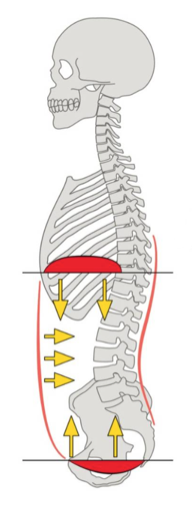
This weakening process is frequently linked to reduced blood flow, which is essential for disc health. Blood flow to the disc decreases when the back side of the spine stays compressed for long periods of time.
That compression often happens in positions that bias spinal extension, such as excessive arching or bending backward. If your body is stuck in postures or movement patterns that consistently load the spine this way, the disc becomes more vulnerable over time.
These patterns are often influenced by stress, habits, and repetitive activities. The solution is not fixating on the disc damage itself, but identifying and correcting the movement patterns that led to both the damage and the ongoing pain.
Understanding this bigger picture is often the missing piece in resolving persistent back pain when imaging alone does not give clear answers.